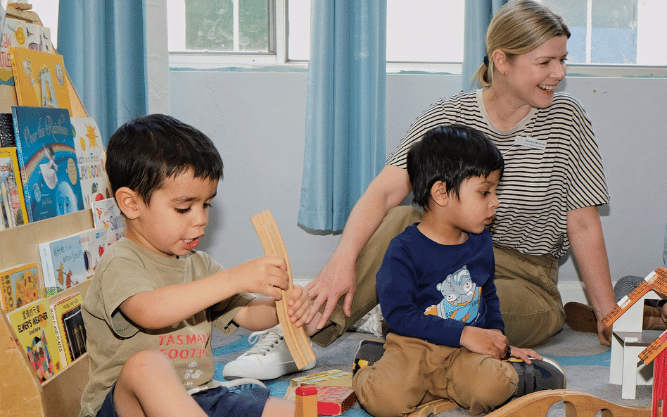
When your child spends their day at an early childhood education and care service, their educators get to know far more than whether they enjoy painting, climbing or story time. They see how your child communicates, moves, plays with others, responds to new experiences and manages everyday routines.
Now imagine those educators working alongside speech pathologists and occupational therapists in the same environment. That is the idea behind integrated early intervention at The Infants’ Home. Allied health professionals work alongside early childhood educators and teachers, allowing children to benefit from their expertisein the space where they already learn and play.
This can mean earlier support for families, greater consistency and fewer gaps between what happens in therapy, early learning and home.
Why Does Early Support Matter?Not every child develops in exactly the same way or at exactly the same pace, but research consistently shows the value of providing children with strong learning and developmental support early. According to the 2021 AEDC National Report, around 23% of Australian children were not developmentally on track in communication skills and general knowledge when they started school.
Early childhood education can make a meaningful difference. Australian Institute of Health and Welfare data shows that in 2015, developmental vulnerability among children who had received some early childhood education and care was 19.9%, compared with 38.5% among children who had not.
The benefits associated with high-quality early childhood education can also extend well beyond the early years. Long-term research published in JAMA Pediatrics found that children who participated in an extended early childhood intervention program were more likely to have completed a bachelor’s degree or higher by age 35, at 14.3% compared with 8.2%.
Together, these findings highlight how important the early years can be and why identifying concerns and providing children with the right support as early as possible can help build strong foundations for learning, communication and participation.
What Do Speech Pathologists and Occupational Therapists Do in Early Learning?Speech pathologists can support children with speaking, listening, understanding and using language, social communication, speech sounds, feeding and other communication needs.
Occupational therapists support the skills children use to participate in everyday life. In early childhood, this can include:
- Movement
- Coordination
- Sensory processing
- Emotional regulation
- Play
- Feeding
- Dressing
- Fine motor skills children use for activities such as drawing and writing
When these professionals are based within an early learning environment, they can see children using these skills naturally rather than only during a separate appointment.
Support Can Begin in the Place Where a Child Already Feels ComfortableA therapy room can tell a professional a great deal about a child, but so can watching them build a tower with a friend, join group time, negotiate the climbing equipment or try to open their lunchbox.
At The Infants’ Home, speech pathologists and occupational therapists work directly within the early learning environment. This gives them opportunities to understand how a child participates in everyday activities and to work with educators to develop strategies that fit naturally into the day.
Strategies Can Be Used Throughout the DayChildren learn through repetition and real experiences. When an educator and therapist work together, a useful strategy does not have to remain something that happens once a week during therapy. It can be incorporated into conversations, mealtimes, transitions, play, group activities and outdoor learning.
A speech pathologist might help educators create more opportunities for a child to communicate during play. An occupational therapist might suggest changes to an activity or environment that help a child participate more comfortably and independently.
It Can Make Support More ConsistentFor parents, one of the most frustrating parts of navigating developmental support can be feeling as though every person involved with your child has a different piece of the puzzle.
Integrated early intervention can help bring those pieces together. At The Infants’ Home, therapists and educators share knowledge and plan support collaboratively. Families are also part of that conversation, helping everyone work towards goals that matter to the child in a more coordinated way. Strategies used by a speech pathologist or occupational therapist can be reinforced by educators and, where useful, carried into routines at home too.
Developmental Needs May Be Identified EarlierYou do not always know in advance that your child will need additional support. Sometimes a concern becomes apparent over time. Perhaps your child is becoming increasingly frustrated when trying to communicate, finds certain everyday tasks difficult, avoids particular sensory experiences or needs more support joining play with other children.
Having allied health professionals regularly working alongside educators creates more opportunities for these patterns to be noticed and discussed early. At The Infants’ Home, all children have access to the Integrated Team, with the level of support increasing when a child or family needs more focused or coordinated assistance.
It Can Make Life Easier for FamiliesParents of young children already have a lot to fit into a week. Travelling between childcare, work, home and separate appointments can make accessing support hard. Integrated services allow some developmental support to happen within the environment where your child already spends their day. The Infants’ Home also offers separate speech pathology and occupational therapy services for children from birth to nine years when individual or group therapy is appropriate.
An Early Learning Centre With More Support Around Your ChildAt The Infants’ Home, speech pathologists and occupational therapists are part of that environment. They work alongside educators to support children’s communication, participation, independence, learning and wellbeing while recognising that every child brings their own strengths and way of experiencing the world.
Book a tour to see our early learning environments and learn more about how our Integrated Team supports children and families.
Frequently Asked QuestionsQ: Does Having Allied Health Professionals Onsite Mean My Child Will Automatically Receive Therapy?
A: No. At The Infants’ Home, allied health professionals contribute to the early learning environment for all children. When a child needs more focused support, the team can work with their family to decide on appropriate goals, strategies and next steps.
Q: What Can an Occupational Therapist Help a Young Child With?
A: An occupational therapist can support many of the skills children use every day, including play, movement, coordination, sensory processing, emotional regulation, dressing, feeding and fine motor activities. Their focus is helping children participate as confidently and independently as possible in activities that matter to them.
Q: What Can a Speech Pathologist Help With in Childcare?
A: Speech pathologists can support children with understanding and using language, speech sounds, social communication, listening, feeding and other communication-related skills. In an early learning centre, they can also work with educators to build communication opportunities into everyday play and routines.